“Does body count matter?” is too broad a question. Matter for what: attraction, values, sexual health, fidelity, relationship satisfaction, or Divorce? A partner count can also matter as a preference without being a reliable measure of character.
The narrower claim considered here is whether the number of premarital sexual partners predicts the dissolution of a first marriage in the United States.
Wolfinger’s 2016 analysis
Nicholas Wolfinger analyzed women in the 2002, 2006-2010, and 2011-2013 waves of the National Survey of Family Growth. Among women who married in the 2000s, 6 percent of those who entered marriage as virgins divorced within five years, compared with 30 percent of women reporting two premarital partners and 33 percent of those reporting ten or more. Women reporting three to nine partners had lower five-year divorce rates than women reporting two.
The pattern was not a simple dose-response relationship in which every additional partner steadily increased the probability of divorce. It also changed across marriage cohorts. Women with two partners had the highest five-year divorce rates in the 1980s and 1990s, while the ten-or-more group had the highest rate in the 2000s. Even then, the difference between the two-partner and ten-or-more groups was not statistically significant.
Wolfinger adjusted for race, family structure while growing up, urban or rural residence, age at marriage, and church attendance. These controls explained no more than about a quarter of the association. However, this was a research brief based on cross-sectional survey data, limited to women, with relatively few available controls. Wolfinger explicitly allowed that the association could be spurious and driven by unmeasured personal characteristics.
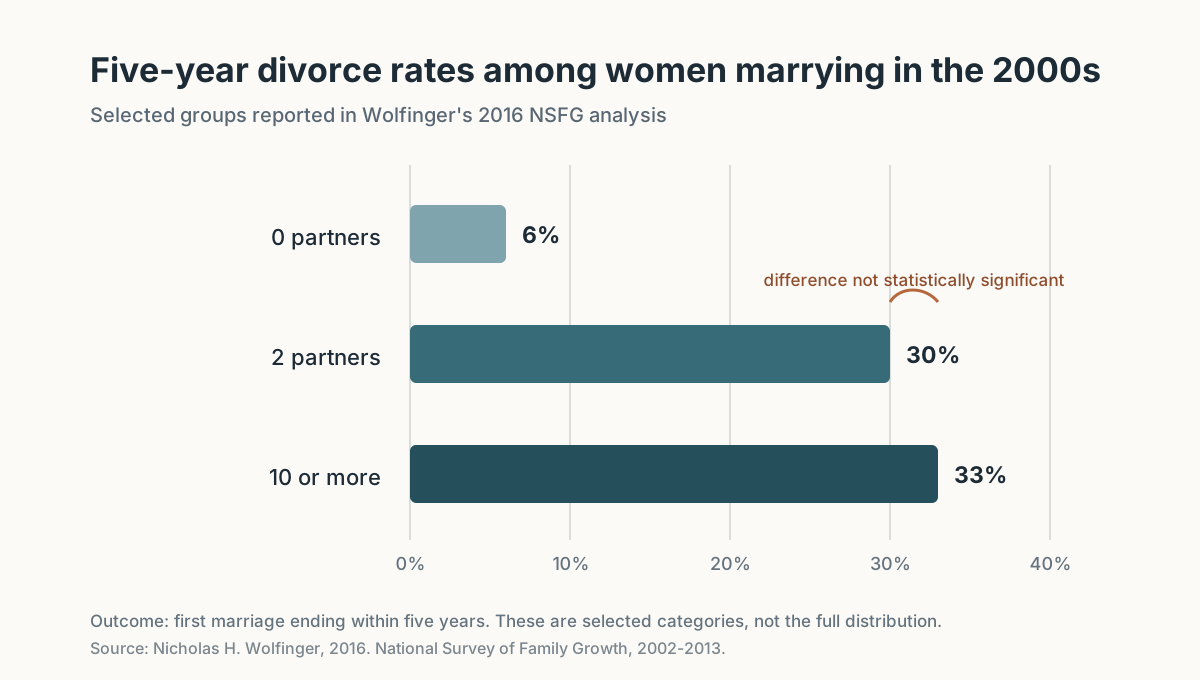
The chart shows only the three groups for which the brief gives exact rates in its text. It does not imply that the omitted categories lie on a straight line.
Smith and Wolfinger’s later study
Jesse Smith and Nicholas Wolfinger later used longitudinal data from the National Longitudinal Study of Adolescent to Adult Health. The study followed American adolescents into adulthood and analyzed 7,030 ever-married respondents. Unlike the 2016 analysis, it included both men and women and measured several characteristics during adolescence, before most marriages occurred.
The authors compared people with no premarital sexual partners other than an eventual spouse against those who had other partners. In the late-marrying subsample of about 3,500 people, the fully adjusted model found three broad tiers:
| Premarital partners other than the eventual spouse | Odds of first-marriage dissolution relative to none |
|---|---|
| 0 | reference |
| 1-8 | 1.64 times |
| 9 or more | 3.20 times |
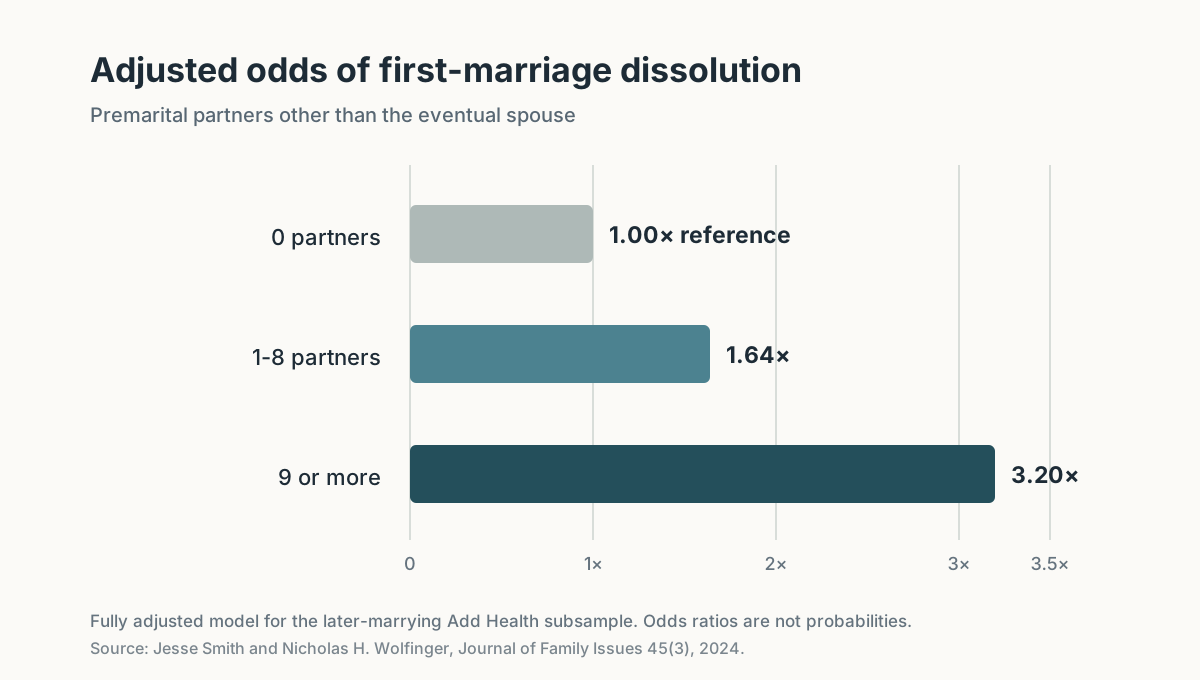
The association persisted after controls for adolescent religious background, beliefs about sex, depressive symptoms, delinquency, cautious decision-making, parent-child relationships, education, family transitions, age at marriage, premarital birth, cohabitation, age at first sex, and reported coercive sex as a minor. The study found no evidence that the association differed between men and women.
These categories are roughly comparable to Wolfinger’s 2016 categories, but not identical. The earlier analysis counted all premarital partners and generally assumed that a woman’s sole partner was her future husband. The later analysis attempted to exclude the eventual spouse, so its nine-or-more category roughly corresponds to ten or more total premarital partners.
What this establishes
Premarital partner count appears to contain information about the probability of an early Marriage ending. The later study weakens several simple selection explanations, including the idea that the association is entirely an artifact of religiosity or permissive adolescent attitudes. It also gives no support to treating this as a uniquely female phenomenon.
It does not establish that accumulating partners causes divorce. Statistical controls cannot eliminate Selection Bias from traits the survey did not measure, and the authors say that unmeasured selection remains possible. Their participants were no older than 32 at the last wave used, so the results mostly concern younger marriages and earlier dissolutions. The partner counts were self-reported and imperfectly timed; the more detailed count was only usable in the later-marrying subsample. Odds ratios are also not absolute probabilities and should not be read as saying that a particular individual is three times as likely to divorce.
Most importantly, neither study answers whether a person’s history should matter morally or romantically. They examine one outcome in one country: first-marriage dissolution. They do not directly establish effects on fidelity, present compatibility, the quality of a marriage, or whether staying married is always the better outcome.
Provisional takeaway
Body count matters as a statistical predictor of marital dissolution in these American datasets, especially at the high end. The relationship is nonlinear, is not limited to women, and has not been shown to be causal. That is meaningful evidence, but it is much narrower than the cultural claim that body count reveals a person’s worth or fitness as a partner.
Questions to pursue
- Does the association survive controls for adult personality, sociosexuality, infidelity, relationship history, and partner characteristics?
- Does partner count predict marital quality as well as dissolution?
- How much do results vary across cultures, generations, and definitions of sex?
- Is partner count itself informative, or is it a proxy for patterns such as casual sex, repeated breakups, or difficulty sustaining commitment?
References
- Wolfinger, Nicholas H., “
Counterintuitive Trends in the Link Between Premarital Sex and Marital Stability,” 2016.
- Smith, Jesse, and Nicholas H. Wolfinger, “
Re-Examining the Link Between Premarital Sex and Divorce,” Journal of Family Issues 45(3), 2024. First published online in 2023.